
CRESTED GECKO MORPHS
Click on the images to learn more about each respective morph or trait. We’re actively expanding and refining this library, so a few links may be temporarily unavailable as updates are completed.


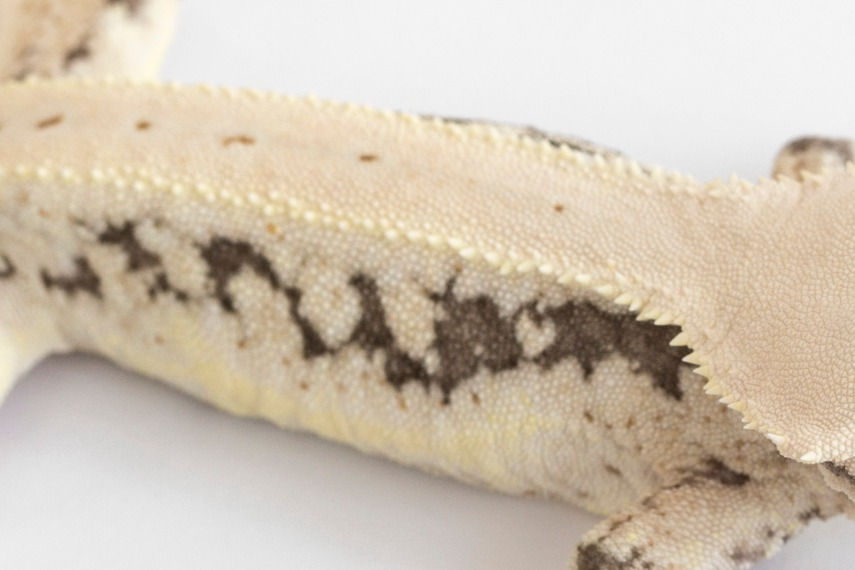


Pixel Crested Gecko Morph


Sable Crested Gecko Morph


The Crested Gecko has become increasingly popular among reptile enthusiasts since its introduction into the herpetoculture industry. It is one of the few geckos that exhibits great variations in its colors, patterns and structure. Over the years, experienced breeders have been able to refine traits that are present in wild Crested Gecko populations and take them to a whole new level. Many new colors, morphs and structure traits have been developed through several generations of selective breeding. In this Crested Gecko Morph Guide we will be taking a look at the wide variety of colors and patterns that they come in.
AXANTHIC CRESTED GECKO


Axanthic crested geckos are defined by their reduced yellow and red pigmentation, resulting in a distinctly cool-toned appearance. Instead of typical warm hues, Axanthics display shades of silver, grey, charcoal, deep brown, and near-black tones, often enhancing contrast and allowing structure, pattern, and white patterning to stand out more prominently.
The Axanthic morph is recessive, meaning a gecko must inherit the gene from both parents to visually express it, while single-copy carriers appear normal but can produce Axanthic offspring when paired correctly.
High-quality Axanthic animals are evaluated based on depth of tone, color cleanliness, and overall contrast. Slight traces of warmth may occasionally appear in some individuals and are considered normal. Because of their unique coloration, Axanthics are highly valued in breeding projects where their cool base tones can strongly influence the final look of many pattern and structure combinations.
SABLE, CAPPUCCINO & HIGHWAY CRESTED GECKO


Sable, Cappuccino, and Highway are currently recognized as different variations of the same incomplete dominant gene, originally identified in separate collections but shown through breeding results to behave as a shared allelic complex occupying the same genetic locus. Pairings between these variations follow the same inheritance pattern, confirming that they are expressions of the same gene rather than separate standalone morphs.
Animals carrying a single copy of the gene typically display darker overall coloration, a recognizable tail identifier that may extend across half, three-quarters, or most of the tail, and in many cases increased white dorsal patterning that can migrate upward into the head crests, creating a brighter crest-lined appearance. Of the three variations, Sable and Highway are generally the most similar to each other pattern-wise, though all three can appear very similar overall, particularly to those unfamiliar with the subtle identifying traits.
When different variations within this gene complex are paired together, they can produce distinct combined super forms, further demonstrating that these are interacting allelic versions of the same gene. For example:
-
Cappuccino × Sable produces the Luwak form
-
Highway × Sable produces the Mable form
-
Highway × Cappuccino produces its own distinct visual super expression
The resulting phenotypes differ visually depending on the specific variation combination involved. However, super forms remain an area of ongoing evaluation. Super Cappuccino (Frappuccino) and Super Highway have been associated with significant health concerns, while Super Sable has not shown consistent issues to date. Because the long-term health outcomes of many super combinations are still not fully understood, careful consideration should be taken before intentionally producing double-gene pairings.
PATTERNLESS CRESTED GECKO


As the name suggests, a patternless crested gecko lacks visible lateral patterning. They come in a wide range of base colors, including cream, yellow, orange, pink, red, brown, dark brown, tan, and olive. This is one morph where less is more—the fewer spots or markings present, the higher the quality of the animal.
Patternless geckos are excellent outcross animals for producing Harlequin, Pinstripe, and Flame projects, as they allow base color to pass through cleanly. This is how we produced Blush (Alpha X Peaches), one of our Pink Extreme Harlequins.
BICOLOR CRESTED GECKO


Bicolor crested geckos are best described as Phantom-type animals that display a distinct color contrast between the dorsal (back) and the lateral body coloration. Rather than heavy patterning, Bicolors are valued for their clean appearance and clearly defined separation between the darker dorsal color and the lighter tones along the sides, limbs, and lower body.
Bicolor is not a single-gene morph, but a line-bred appearance trait, meaning expression can vary depending on lineage and selective breeding strength. High-quality examples are typically judged by the clarity of the dorsal-to-lateral contrast, overall color richness, and the cleanliness of the two-tone separation.


TIGER CRESTED GECKO
Tiger Crested Geckos are exactly what they sound like. They have darker bands that run vertically from their backs down the sides of their body and can come in different colors. Super Tiger Crested Geckos will have exaggerated striping compared to a regular tiger. The first gecko in the gallery is Cringer, one of our Super Tiger breeders.
BRINDLE CRESTED GECKOS
A Brindle crested gecko is similar to a Tiger in overall appearance, but with a key distinction. Instead of continuous vertical bands, the pattern is fragmented and irregular, creating a marbled or “broken stripe” look across the body.

DALMATIAN CRESTED GECKO


Dalmatian Crested Geckos have black, green or red spots of varying size and density. The spots can sometimes be so large and clustered that they are referred to as Inkblots or ink spots. Dalmatian spots can be found in pretty much all the morphs regardless of their visible traits. However, for a Crested Gecko to truly be called a Dalmatian, the spots should be accompanied with little to no pattern on the body and limbs.
SUPER DALMATIAN CRESTED GECKOS
Super Dalmatians display a much higher concentration of spots than standard Dalmatians. A commonly used guideline is spot count—if a gecko has over 100 spots, it is generally considered a Super Dalmatian.
FLAME CRESTED GECKO


A Flame Crested Gecko is very similar to a Bi-Color, the key difference being contrast and color. A Flame’s contrasting color will usually be quite different than the base color and can come in white, cream, yellow or orange. The contrasting color will run along the head and dorsum of the gecko. Flames typically show little to no pattern at all on the sides or limbs of their bodies.
CREAMSICLE CRESTED GECKO


Creamsicle Crested Geckos are orange and white/cream but have also been known to come in yellow and cream. They come as Pinstripes, Harlequins and Flames. The one shown in the photo is a Lilly White Creamsicle.
HARLEQUIN CRESTED GECKO


Harlequin Crested Geckos are a lot like Flame Crested Geckos with one key difference, Harlequins have a lot more pattern on their sides and limbs. In general, the more pattern the nicer the harlequin.
Extreme Harlequin Crested Gecko
This is a gecko with even more pattern than your regular harlequin. The pattern from both the dorsum and laterals of the gecko will start migrating into each other. Sometimes a gecko can have soo much pattern that it starts looking like a patternless Crested Gecko.
PINSTRIPE CRESTED GECKO


Pinstripes are generally thought of as a structural trait and consists of raised, cream or other colored scales. These scales run along the outside of the dorsal and can span from the head all the way to the base of the tail of a Crested Gecko. These raised scales can either match the color of the rest of the dorsal or contrast against it. A full Pinstripe is generally considered more desirable depending on the other traits of the gecko.
Partial Pinstripe
If the pinstripes are broken up and do not connect the head to the tail it is defined as a partial pinstripe.
Reverse Pinstripe
This is a non-structural trait. Reverse pinning will give the appearance of a shadow effect underneath the outside of the actual pinstripes. This darker color will run along the top of the lateral area and just beneath the dorsum/pinstripe scales.
HALLOWEEN CRESTED GECKO


Just like it sounds, Halloween Crested Geckos come in the color combo black and orange. Subtle variations in the darkness of the base color and the color orange is fine. A gecko is not considered a Halloween if the contrasting pattern is clearly yellow or cream.
QUAD-STRIPE CRESTED GECKO


Quad-stripe Crested Geckos are similar to regular pinstripes with the addition of two well defined lateral stripes on the gecko's body. The lateral lines should span the majority of the area between the front and back legs of the gecko. Quad-Stripe Crested Geckos can also have some of the same traits that regular pinstripes do.
LILLY WHITE CRESTED GECKO


Lilly White Crested Geckos are one of the very few genuine genetic morphs cultured in captivity and are characterized as having a lot of white/cream marking on their bodies. Over the last few years, they have created a lot of hype in the Crested Gecko market. These are truly magnificent looking geckos which come in a variety of secondary morphs such as Pinstripes and Harlequins.
High Expression Lilly White Crested Gecko
These have even more white markings than your usual looking Lilly white.